
💡Direct answer
A 13-week cash flow forecast is a week-by-week projection of the cash coming into and going out of your business over the next quarter. You build it by starting from your actual bank balance, listing the receipts and payments you expect in each week, and updating it every week as real numbers replace estimates. Thirteen weeks is long enough to see a cash gap coming and short enough to forecast with real accuracy.
At Detweiler Hershey, the 13-week forecast is one of the first tools I build for clients in the CFO/FP&A tier of our RAMP Advisory Services. I’m Michael Mazza, a partner at the firm, and I work with owners in Souderton, Harleysville, Telford, Lansdale and across the Indian Valley whose businesses are growing faster than their bank balance can comfortably follow.
This guide covers what the forecast is, how to build one step by step, and how to keep it useful after the first week.
What is a 13-week cash flow forecast?
It’s a short-range cash plan laid out in weekly columns. Each week shows your beginning cash, the cash you expect to collect, the cash you expect to pay out, and the cash you’ll have left at the end.
It is not a profit and loss statement. Your P&L tells you whether you earned money. The 13-week forecast tells you whether you’ll have money in the bank on a specific Friday. Those are different questions, and a profitable business can get the second one wrong.
It is also rolling. Every week, the week that just ended drops off, a new week 13 is added, and you compare what you forecast to what actually happened.
Why 13 weeks instead of 12, or a full year?
Thirteen weeks is exactly one quarter (52 weeks divided by four). That means the forecast always captures a full cycle of quarterly payments, like estimated taxes or quarterly insurance, instead of letting one slip just past the edge.
Weekly detail beyond a quarter turns into guessing. Past 13 weeks, you don’t know which customer will pay which invoice in which week. That longer horizon belongs to your annual budget and longer-range forecast, which work in months.
Monthly views also hide timing. Payroll might land on the 15th and the 30th. A large supplier payment might fall in the same week a big customer pays late. The month can look fine on paper while one week inside it doesn’t.
“A monthly forecast can tell you you’ll be fine in March. A weekly forecast tells you that you won’t be fine the second week of March, and that’s the week that matters.”
Michael Mazza, CPA, Detweiler Hershey [DRAFT, Michael to approve]
Which businesses need a 13-week cash flow forecast?
Any business can use one, but it earns its keep fastest when cash timing is uneven. In my experience, that includes businesses that:
- Are growing quickly, so receivables and inventory climb before the cash catches up
- Have seasonal swings in sales or staffing
- Take on large projects with big payments in and out at irregular intervals
- Rely on a line of credit and need to know when they’ll draw on it
- Are weighing a major decision, like a new hire, an equipment purchase or a second location
- Have already felt a cash squeeze and want to see the next one coming
If you’ve ever looked at a strong sales month and wondered why the bank balance didn’t move, the forecast is built for that question. I wrote more about why growth eats cash in Cash Flow Planning for Growing Businesses.
How do you build a 13-week cash flow forecast, step by step?
- Start with your actual cash today. Use a reconciled bank balance, not the number in your head or an unreconciled ledger. If your books aren’t current, fix that first: a forecast built on stale numbers is only a confident guess. Our guide to the month-end close process covers how to get there.
- Set up the grid. Thirteen columns, one per week. Rows for beginning cash, cash receipts by category, cash payments by category, net cash flow, ending cash, and a minimum cash floor.
- Forecast receipts from receivables, not revenue. Start with your open accounts receivable aging. For each customer, use when they actually pay, not when the invoice says they should. Then add new sales you expect to invoice and collect inside the 13 weeks. Be conservative here; this is where most forecasts go wrong.
- Put every payment in the week it leaves the bank. Payroll and payroll taxes on their actual dates. Rent, loan payments and leases. Supplier payments based on your terms. Credit card payments. Quarterly estimated taxes, insurance premiums, owner distributions and any planned equipment purchases.
- Calculate ending cash and compare it to your floor. Every week’s ending cash becomes the next week’s beginning cash. Any week that drops below your minimum is a flag.
- Decide what to do about each flagged week now. Follow up early on a large receivable. Talk to a supplier about timing. Push a discretionary purchase back a few weeks. Arrange a draw on your line before you need it, not the morning payroll is due.
- Roll it forward every week. Replace last week’s forecast with actuals, add a new week 13, and look at where you were off. The variances teach you which assumptions to fix.
What does a 13-week forecast look like in practice?
Here’s the first four weeks of a simplified forecast for an illustrative business with biweekly payroll and a $40,000 minimum cash floor. (Illustration only, not a client.)
| Week | Beginning cash | Receipts | Payroll | Suppliers | Other payments | Ending cash |
|---|---|---|---|---|---|---|
| 1 | $85,000 | $42,000 | $38,000 | $12,000 | $9,000 | $68,000 |
| 2 | $68,000 | $35,000 | $0 | $18,000 | $4,000 | $81,000 |
| 3 | $81,000 | $30,000 | $38,000 | $21,000 | $29,000 | $23,000 |
| 4 | $23,000 | $55,000 | $0 | $10,000 | $9,000 | $59,000 |
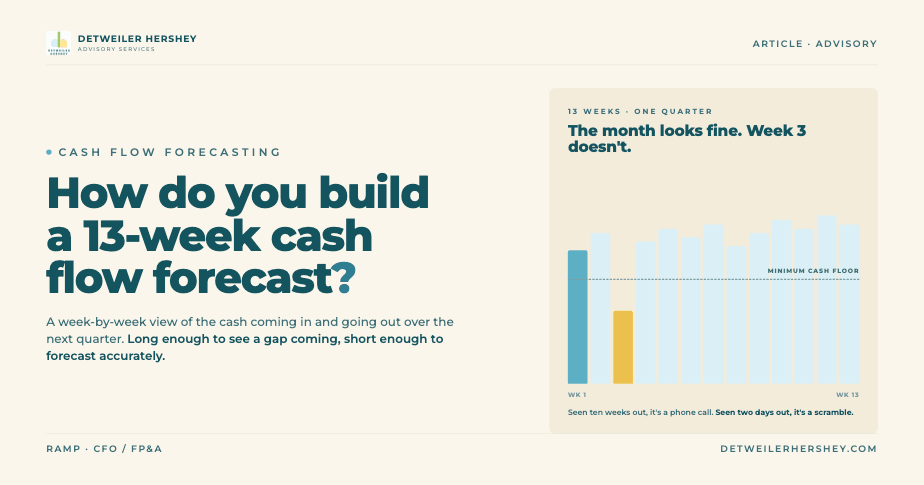
Over the full month, this business looks fine. It starts at $85,000 and ends at $59,000, with no week anywhere near zero.
Week 3 tells a different story. A payroll, a heavy supplier week and a quarterly estimated tax payment all land together, and cash drops to $23,000, well under the floor. The big customer payment that fixes it doesn’t arrive until week 4.
Seen ten weeks out, that’s a phone call: ask the customer for an earlier payment, shift a supplier payment by a week, or plan a short draw on the line. Seen two days out, it’s a scramble.
What are the most common 13-week forecast mistakes?
- Forecasting sales instead of collections. Revenue you booked isn’t cash until the customer pays.
- Starting from unreconciled books. If the starting balance is wrong, every week after it is wrong. If you suspect your books have that problem, The Real Cost of Bad Bookkeeping covers the warning signs and the fix.
- Assuming customers pay on terms. Use each customer’s real payment history.
- Forgetting irregular payments. Annual insurance, quarterly taxes, year-end bonuses and equipment purchases are the ones that cause surprises.
- Building it once. A forecast that isn’t rolled forward weekly goes stale within a month.
- Keeping it in one person’s head. If the owner is the only one who knows the numbers, the forecast disappears the week the owner gets busy.
How does the 13-week forecast fit with your budget and long-range plan?
Think of them as three lenses on the same business.
Your annual budget sets the targets for the year. Your longer-range forecast (often 12 to 24 months, by month) shows where the business is heading and what it can afford. If those terms blur together, our post on budgets vs. forecasts sorts them out.
The 13-week forecast is the operating tool. It tells you whether this quarter’s cash supports the plan, week by week. For Aunt Wendy’s Kiffles, our team maintains two-year forecasts alongside the monthly financials; shorter-range cash views sit underneath that kind of plan.
The cash number also feeds your monthly review. Cash position, and how long it will last, is the first of the five numbers I cover in What KPIs Should a Business Owner Track Every Month?
Should you build the forecast yourself or have it built for you?
A spreadsheet is enough. The hard part isn’t the software. It’s the weekly discipline of updating it and the judgment to act on what it shows.
Many owners can build a first version themselves using the steps above. Where it breaks down is consistency: the forecast gets skipped during a busy month, which is usually the month it was needed most.
In our RAMP CFO/FP&A tier, we build the model with you, tie it to a reliable monthly close, and walk through it with you on a regular rhythm, so the forecast is current when a decision comes up.
Frequently asked questions
Is a 13-week cash flow forecast the same as a cash flow statement?
No. A cash flow statement reports what already happened over a past period. A 13-week cash flow forecast projects what will happen, week by week, over the next quarter. One explains the past; the other helps you manage the next three months.
How long does it take to build a 13-week cash flow forecast?
The first version takes the most time, because you’re gathering receivables, payment dates and recurring costs in one place. Once it’s built, rolling it forward each week is a much shorter task, mostly replacing estimates with actuals and adding a new week 13. The weekly update is what keeps it useful.
Can I build a 13-week forecast in QuickBooks?
Your accounting software supplies the inputs: bank balance, open receivables and upcoming bills. Most businesses still build the forecast itself in a spreadsheet, because it needs to hold assumptions and timing your software doesn’t track. Simple and updated beats sophisticated and stale.
How much cash should my business keep as a minimum?
It depends on your payroll cycle, fixed costs and how predictable your collections are. I usually start the conversation at one full payroll plus a month of fixed costs, then adjust for the business. [DRAFT, Michael to approve] The forecast shows you how close you run to that floor and how often.
Does a profitable business need a cash flow forecast?
Yes. Profit and cash move on different schedules, especially when a business is growing. Receivables, inventory and equipment purchases can absorb cash even in a strong year, and the forecast shows you when that will happen before it does.
Want a 13-week forecast built for your business?
See how our CFO, FP&A and Controller services work, or reach out to me directly to talk through where your cash is headed this quarter.