
💡 Direct answer
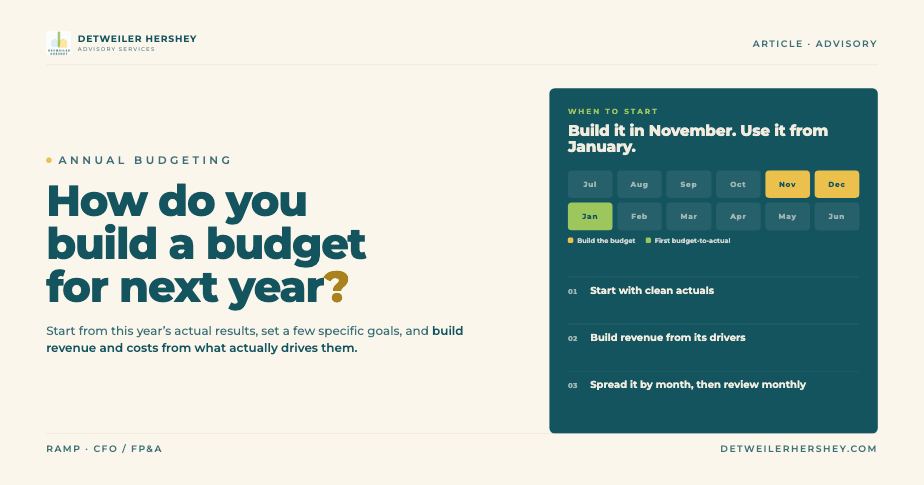
To build next year’s budget, start from this year’s actual results, set a few specific goals, build revenue from the things that drive it, and build costs from what it takes to deliver that revenue. Then spread the year by month and review it against actual results every month once January starts. The best time to do this is November and December, while this year’s numbers are nearly final and next year’s decisions are still open.
I’m Michael Mazza, a partner at Detweiler Hershey in Souderton. Every fall, I sit down with business owners across the Indian Valley to build the plan for the coming year. At Detweiler Hershey, that budgeting work is part of the CFO/FP&A tier of our RAMP Advisory Services, where it connects directly to the monthly close and the forecast.
Here’s how I approach it, step by step.
When should a business start next year’s budget?
Now. For a calendar-year business, November is the right month to start.
By November you have ten months of actual results and a reasonable estimate of the last two. That’s enough to see this year’s real patterns without waiting for December to close.
Year-end decisions also depend on the budget. Whether to buy equipment before or after December 31, when to hire, and what to pay in bonuses all affect both next year’s plan and this year’s tax picture. Making those calls with a draft budget in hand beats making them in the last week of December.
And a budget finished in January is already behind. The first month of the year is the first month you should be comparing actual results to plan.
What is the difference between a budget and a forecast?
A budget is your plan for the year: what you intend to earn and spend. It’s set once and stays fixed, so you can measure against it.
A forecast is your current best estimate of where the year will actually land. It changes as reality changes. You need both, because the gap between them is where the useful conversation happens. Our post on budgets vs. forecasts covers the distinction in more depth.
How do you build a budget for next year, step by step?
- Start with clean actuals. Pull this year’s results through the most recent closed month, reconciled, and estimate the rest of the year. A budget built on unreconciled books carries this year’s errors into next year’s plan.
- Set two to four goals. Be specific: a revenue target, a gross margin target, a hire, a piece of equipment, a cash reserve. Goals are what the rest of the budget has to support.
- Build revenue from its drivers. Instead of taking this year’s sales and adding a percentage, ask what produces revenue. How many customers, buying how much, at what price? What’s recurring, and what has to be won? Then spread it across the months your business actually sells in.
- Build direct costs from revenue. Materials, direct labor and subcontractors should move with the revenue they support. If your gross margin this year was 38 percent, the budget should explain why next year’s would be different, not assume it.
- Build overhead line by line. Start with known changes: lease escalations, insurance renewals, software, wage increases. Add each planned hire with a start month and a fully loaded cost, including payroll taxes and benefits.
- Add what hits cash but not the P&L. Loan principal, equipment purchases, owner distributions and estimated tax payments don’t all show up as expenses, but they all leave the bank account.
- Spread it by month. An annual total can’t be reviewed against a single month’s results. Use your real seasonality, not twelve equal slices.
- Test a downside case. Ask what happens if your largest customer slows down or a key cost rises. If the downside case breaks the plan, you want to know that now.
- Set the review rhythm. Decide now when budget-to-actual will be reviewed each month, and who will be in the room.
What should an annual business budget include?
| Section | What goes in it | Where the number comes from |
|---|---|---|
| Revenue | Sales by product, service or customer group, by month | Customer counts, volume and pricing, adjusted for seasonality |
| Direct costs | Materials, direct labor, subcontractors | Tied to revenue and your target gross margin |
| Overhead | Rent, salaries, insurance, software, marketing, professional fees | This year’s actuals, adjusted line by line for known changes |
| New hires | Role, start month, fully loaded cost | Your hiring plan |
| Capital spending | Equipment, vehicles, technology, buildouts | Your goals for the year, timed by month |
| Financing | Loan principal and interest, line of credit activity | Current loan schedules and expected borrowing |
| Owner distributions and taxes | Distributions, estimated tax payments | Your tax plan and cash needs |
What mistakes do business owners make with annual budgets?
- Last year plus five percent. It’s fast, but it bakes in last year’s problems and ignores what actually drives the business.
- Budgeting profit and ignoring cash. A budget can show a strong profit while the bank balance runs tight, especially if you’re buying equipment or growing receivables.
- Annual totals only. Without monthly detail, you can’t tell in April whether you’re on track.
- Building it alone. If managers who control spending weren’t involved, they won’t own the numbers.
- Never looking at it again. A budget nobody reviews is a wish list. [DRAFT, Michael to approve]
- Treating it as a prediction. The budget isn’t supposed to be right. It’s supposed to show you, early, where the year is going differently than planned.
How do you use the budget once the year starts?
The budget earns its value in the monthly review. Each month, compare actual results to the budget, line by line where it matters, and ask two questions: why is it different, and what does that change about the rest of the year?
Results against plan is one of the five numbers I cover in What KPIs Should a Business Owner Track Every Month? It depends on a month-end close that finishes on time every month, because budget-to-actual is only useful while the month is still fresh.
The annual budget also sits above your shorter-range cash planning. The budget sets the year; a 13-week cash flow forecast [confirm URL after Nov 14 publish] tells you whether this quarter’s cash supports it.
How does Detweiler Hershey help with budgeting?
In our RAMP CFO/FP&A tier, we build the budget with you from reconciled numbers, connect it to your monthly financial statements, and review budget-to-actual with you on a regular schedule. Budgeting is one piece of the broader planning work I describe in What Is FP&A, and Why Does a Growing Business Need It? Because Detweiler Hershey also handles tax planning, the budget and the year-end tax plan can come from the same set of numbers instead of two separate conversations.
That’s the model behind our work with Aunt Wendy’s Kiffles: monthly financials reviewed with the owner, two-year forecasts and tax planning, handled by one team.
Frequently asked questions
How far in advance should I build next year’s budget?
For a calendar-year business, start in November and finish by mid-December. That gives you nearly a full year of actual results to work from and time to make year-end decisions with the plan in hand. If your fiscal year ends at a different time, start about two months before it closes.
Should a small business use zero-based budgeting?
Fully zero-based budgeting, where every line starts from nothing, is more work than most small businesses need every year. I prefer building revenue from its drivers and reviewing overhead line by line, asking whether each cost still earns its place. That catches most of the waste without rebuilding everything from scratch.
How much should actual results differ from the budget?
Some difference every month is normal and expected. What matters is whether you can explain it and whether it changes the rest of the year. I look harder at any line that misses by more than about 10 percent, or by a dollar amount that matters to the business. [DRAFT, Michael to approve]
Do I need a budget if I already have a forecast?
Yes. A forecast tells you where you’re heading; a budget tells you where you meant to go. Without the budget, there’s nothing to measure the forecast against, and drift goes unnoticed until year-end.
Who should be involved in building the budget?
The owner sets the goals, but anyone who controls revenue or spending should have input on their part of the plan. Your accountant or outsourced CFO should build the structure and check that the numbers tie to your actual results and cash.
📞 Want help building next year’s budget before January?
See how our CFO, FP&A and Controller services work, or reach out to me directly to get the plan in place before the year starts.